Vintage Sequential Circuits Prophet 10 Dual Keyboard Version 3 Analog Synthesizer with Flight Case, Footswitch
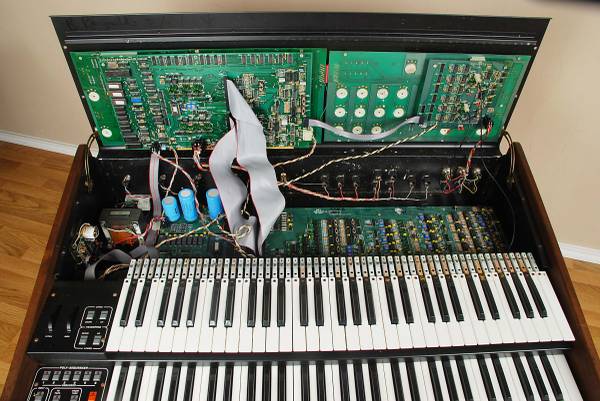
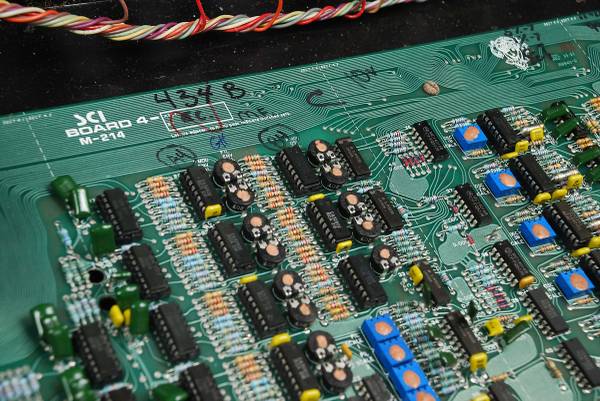
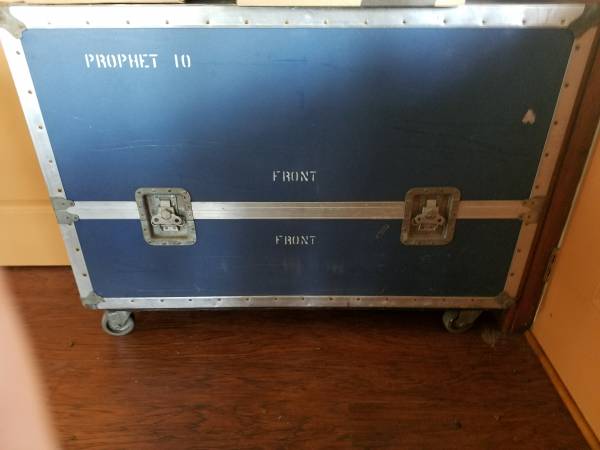
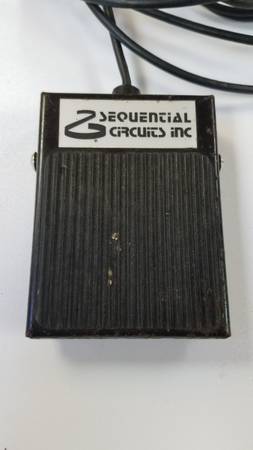
Very nice example of a Version 3 Prophet 10 synthesizer, S/N 0444. Very good condition, fully functional (have not checked the Braemer tape drive). Includes the original P10 flight case, one original SCI footswitch, and copies of the operation and service information. Has not been played out since I got it 20 years ago. Has MIDI in/out.
In 1980 a working 10-voice, 20-oscillator, double-manual keyboard, Prophet-10 made it into production. One of the largest analog synths available at the time, the Prophet-10 featured much of the same architecture as the Rev. 3 Prophet-5. Like the Prophet-5, each voice consisted of two VCO's (voltage controlled oscillators) and a white noise source, all of which can be mixed into a resonant low-pass VCF (voltage controlled filter). The filter modifies the voice timbre under control of its four-stage envelope generator. The filter may also be resonated and serve as a sound source. Following each filter, a VCA (voltage controlled amplifier), also controlled by a four-stage envelope generator, shapes the voice amplitude. Supplementing the basic voices are polyphonic modulation (POLY-MOD) signal routings within each voice that allow VCO2 and the filter envelope generator to function as modulation sources applied to VCO1 frequency, pulse width, or the filter frequency. Finally, there is a single LFO (low-frequency oscillator) and a pink noise source which can be mixed to modulate all voices, as adjusted by the MOD wheel. All of the voice settings, along with settings for volume and tuning, could be saved and instantly recalled on a total of 32 memory locations (4 banks of 8). Some early Prophet-10's were recalled because of problems with memory loss. For this, Sequential performed what they affectionately called the "Ugly Mod", which reportedly fixed the problem.
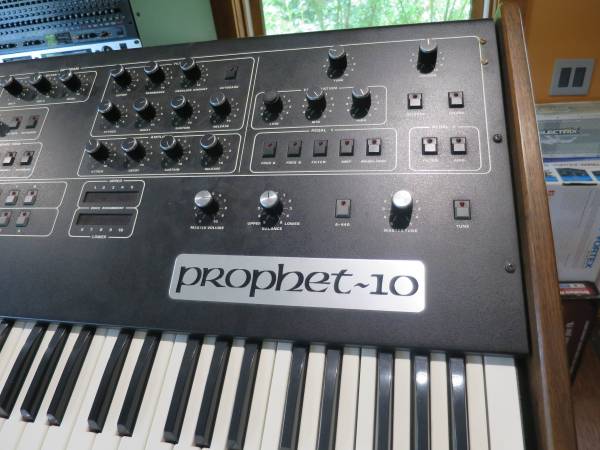
The Prophet-10 features two complete sets of program switches with corresponding LEDs that light up to show you which voice is playing. To the right of the program switches are the master volume knobs and tuning aids, including an A-440 tone module, a master tune knob, and the autotune button. To the right of what otherwise looks much like a Prophet-5 front panel is an extra section. Here are the programmable volume and tuning knobs, and switches for routing the input from two available footpedals. Destinations are pitch, cut-off, VCA, or mono modulation. As in the Prophet-5, there is also a release switch.
The Prophet-10 was special. More than simply two Prophet 5s in a box, it was a sonic monster that could allocate its ten voices in several modes ranging from a 2-oscillator-per-note 10-voice synth, to a monosynth with 20 analogue oscillators under a single key. It was easy to program powerful analogue pads and luscious, deep strings, and if you wanted screaming leads, chunky bass patches, distorted filters, tortured resonance, and a doubled unison mode that made speakers spontaneously ignite, a Prophet 10 stood head-and-shoulders above almost every other synthesiser. You could also use the 10 as two entirely independent synthesisers playing, for example, a unison lead on the upper manual, with a powerful polyphonic accompaniment on the lower. OK, so the ability to perform multiple duties is meat and drink to modern multi-timbral instruments, but the 10 still scores in the depth and the power that it can create. One of the greatest advantages of the P-10 over the P-5 is the dynamic voicea allocation mode, where voices bounce between the 2 patches and over the stereo field. Makes it sound huge.
Above the two groups of program selector switches are the keyboard mode switches. The two keyboards can be configured to the following modes:
* Normal Mode - This mode set the Prophet-10 up with two separate 5-voice polyphonic keyboards.
* Single - This mode created a 10-voice polyphonic instrument which could be played on either or both keyboards.
* Double - This mode creates a 5-note polyphonic layered sound using both patches. This 4-VCO sound can be played on either or both keyboards.
* Alternate - This mode alternates between the two patches selected. One note would be the first patch and the next note played, on either keyboard, will be the second patch.
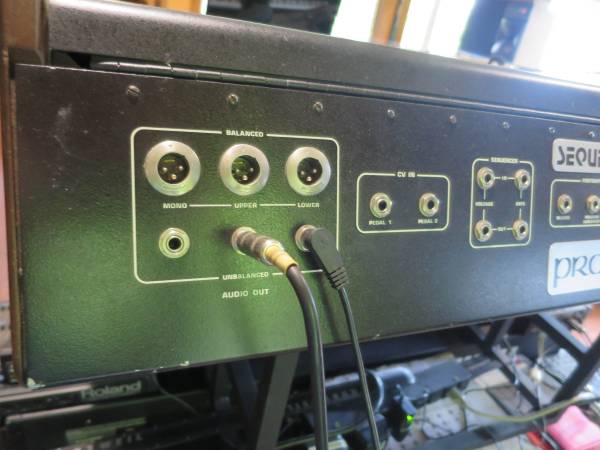
On the back of the Prophet-10 are two sets of outputs, three XLR (balanced) outputs and a three 1/4" jack outputs. The three outputs correspond to Left, Right, and Mono. Also on the back are two CV (Control Voltage) pedal inputs, and a little matrix of four jack sockets for CV and gate outputs (with last note priority), CV and trigger in (for voice 5 on the upper keyboard), and switch sockets for release, program increments, and sequencer control.
The Sequencer on the Prophet-10 was optional. It could be installed in the factory before the unit was shipped or it could be retro-fitted at a later date. This unit includes the later version 10,000 note sequencer, with the Braemar micro-cassette tape drive. However, the tape drive has not been tested, and the tapes are virtually impossible to obtain (and were unreliable to start with).
The first batch of 10s (of which there were only 300 or so, curiously called Rev 0s) incorporated a 'wafer' drive for backing-up patches and storing any data recorded on the synth's internal 6-track sequencer. These drives, made by Exatron, were plagued by failures and, even when they worked reliably, the back-ups were frequently incompatible from machine to machine. So, when Exatron was taken over in 1982, Sequential swapped to a Braemer micro-cassette drive. This was far more reliable, and stored 10,200 sequencer events compared to the earlier unit's 2,500.
The SCI July 1979 Spec Sheet write-up provides some great reference info:
"Sequential Circuits Polyphonic Synthesizer. The Prophet 10 is a dual-manual (5-octaves each manual) ten-voice synthesizer with 32 user-writable programs available on each keyboard. Extra programs can be stored on cassette tapes. An optional five-voice polyphonic sequencer is also available with a built-in cassette interface for storing sequences. It operates on the bottom keyboard and can be retrofitted into units purchased without the sequencer to begin with. Other features include pitch-bed and modulation wheels, octave transposition switches, assignable voice modes (you can set how many notes you play on each keyboard - you can also control two separate tone colors from the same keyboard), voice-assignment LED indicators to let you know which voice is being triggered at any given time, automatic tuning, programmable volume control, a program increment footswitch, three-band programmable equalization on each keyboard, two assignable and programmable control voltage pedals which can act on each keyboard in the same or different ways, depending on how you program them, two oscillators per voice, ADSR envelope generators, polyphonic modulation section, upper and lower keyboard balance control, an A-440 reference tone, stereo unbalanced and balanced outputs (for separate amping of upper and lower keyboards), and a mono unbalanced and balanced output.
Full pictures are here:
https://drive.google.com/drive/folders/1q81iseNmcoqSQIzAboxleT-Ru-Zx249K?usp=drive_link